Captain: Royal Electrical and Mechanical Engineers
Photo courtesy Philip Smith
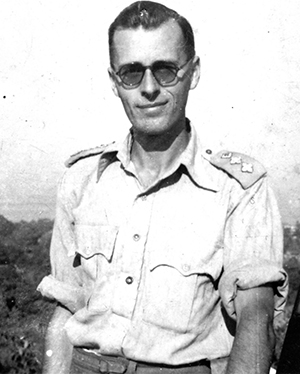
Burma 1945
In his youth Gordon played for the Crich Cricket team of which his father, Percy, was captain.
Photo courtesy Les Barber
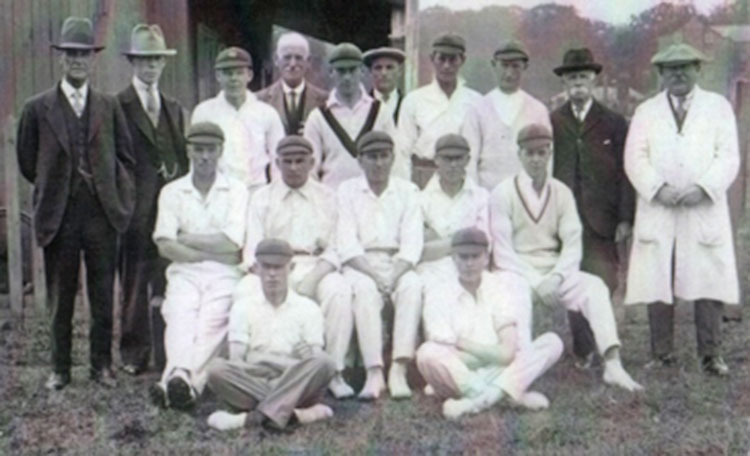
1925: Gordon is sitting on the right at the front . Father Percy (captain) is centre on the row behind
1939 Register: Woodleigh, Crich
Percy Stanley Smith b. 13 April 1889; Electrical Engineer, Wireworks
Beatrice Annie Smith b. 6 Mar 1889; Domestic
Duties
Gordon Percival Smith b. 22 July 1912; Chargehand Maintenance Fitter
1942 Marriage
Gordon P SMITH married Margaret Elizabeth COOK in Q1 of 1942 at Ilford, Essex.
Derbyshire Times 6 February 1942
Margaret was an evacuee to Crich with her pupils where she met Gordon. Below is an article from elsewhere on this site about this period:
During WW2 many evacuees came to stay with families in the Crich area. Also teachers and their children moved into the area – many stayed, or returned, after the war.
Margaret Smith's story
Margaret Smith taught at Ripley Junior School on Shirley Road for many years, certainly into the 1970s. Originally she came to the Crich area from Southend with some her pupils. Some of her reminiscences were recorded in 'Bygone Derbyshire' written by Arthur Satchwell for the Derby Evening Telegraph. The following are transcriptions of undated articles provided by her son Philip Smith.
Seldom a square peg
NATURALLY, there were a few misfits among the wartime evacuees, points out Margaret Smith, of Laund Nook, Belper.
The surprising feature was that there were so few square pegs in round holes, but things got themselves sorted out eventually.
One or two of the children, however, were so desperately homesick that they could not stay.
Luckily we were blessed with six weeks of glorious weather, and Dunkirk and the threatened invasion seemed a long way away from the Derbyshire countryside.
Settled down
"The headmaster of one of the Crich schools generously gave us a classroom — at some inconvenience to his own pupils.
Two of us shared the room and the older children used the Congregational Hall at Fritchley for their lessons. Some of these children walked every day from Plaistow Green, the other side of Crich Stand, to Fritchley and back.
Exercise books, text books and school equipment had been brought with us, and we soon settled down to school life again.
We took the children for walks and picnics during the summer holidays, and, of course, the foster parents included them in their family outings.
The day war broke out
IN THE wake of many anniversaries of the Second World War, Margaret Smith tells of the evacuation of Southend schoolchildren to Derbyshire in June 1940.
Now living in Laund Nook, Belper, she says:" When war broke out in September 1939, I was a young teacher in Southend. At that time we all thought that London and the big industrial cities would be the main targets for the German bombers and that we would be relatively safe.
All this changed in May 1940 when Germany had overrun France, Belgium, and Holland and occupied the Channel ports. Now it was possible that invading troops would come to the mouth of the Thames and make their way to London.
If this happened, Southend would be in the front line of the fighting.
On Sunday, May 26, we heard the announcement on the nine o’clock news . . . "Schools from the following area will be evacuated to reception area next Sunday. Southend was included on the list.
Parents were faced with a heart-rending decision — I still don’t know, after 50 years — what I would have done. Looking back, I don’t suppose Derbyshire would have been very safe once the invaders had landed with their tanks and used Blitzkrieg tactics.
However, with terrifying accounts of events over the Channel, of refugees blocking the roads and being machine-gunned as they fled, the thought of a comparatively safe place for the children was slightly comforting.
Evacuees first glimpse of Derbyshire
AN APPRECIATION of the first glimpse of the Derbyshire countryside is the abiding memory of children evacuated from the East Coast of England, says Margaret Smith, of Laund Nook, Belper.
At the outbreak of the Second World War, in September 1939, she was a young teacher in Southend, as she has previously explained in Bygone Derbyshire.
Mrs Smith says:" We met at school at 4pm on Sunday and boarded buses which would take us to the station.
The parents were wonderfully brave and most of them managed to hide their feelings as they said goodbye to their excited children.
At Southend station we were ushered into trains and the long journey began.
‘A mountain!’
We were on the same train as the boys from Westcliff High School who were also coming to Belper. They would share Herbert Strutt School with local pupils.
At Belper station there were more buses waiting and we were split into different parties — going to Denby and Crich. I was in the group for Crich.
It was a beautiful day and the countryside between Belper and Ambergate looked lovely.
As we went up Bull Bridge Hill one child exclaimed: A mountain!
I have read in recently published books of the ‘cattle market' atmosphere when children were billeted.
There was nothing like that at Crich.
Perhaps lessons had been learned in earlier evacuations in other parts of the country.
Here everything was well planned in advance. It all went smoothly and children were whisked off to their new homes.
Families were kept together or very near to each other.
Some of the older boys went to farms.
And last of all, the teachers found accommodation.
Living with the lists of evacuation
Margaret Smith, of Laund Nook, Belper, came to Derbyshire more than 50 years ago and was involved in the evacuation of schoolchildren from Southend.
Since she retired from teaching Mrs Smith has been ‘back to school’ several times to talk to junior pupils engaged on Second World War topics.
Looking back, she says: School on Monday morning was chaotic. Our school had been taken over by the ARP workers and we were split into small groups meeting in church halls or private houses, but we gathered in the school again to prepare for evacuation — less than a week away now.
Parents came to seek advice. We had no idea where we were going, but instructions came in from headquarters thick and fast and we began to make lists — oh, those lists!
Families were to be kept together, which involved co-operating with infant, junior and senior schools, and in our case the senior school was quite a distance away.
There were lists of clothing which children must take — luggage of course was restricted; lists of children whose families would need help in providing suitable clothing; lists of illnesses which children had had — there was not so much immunisation then; lists of personal difficulties of children, one of which, bed-wetting, was not always mentioned and which caused some upset in foster homes later.
The day before we left, Saturday June 1, 1940, we were told that we would be going to ‘an oil-refining town in Derbyshire — Belper.’ When we went for a last walk along the seafront, late on Saturday night, and saw soldiers with fixed bayonets, and barbed wire and concrete blocks in evidence, we counted ourselves fortunate to be leaving."
Margaret Elizabeth COOK
Born 5 August 1918, Essex
Died 17 May 2008, Belper
Gordon and Margaret had two sons, one of whom was born at Willersley Castle, Cromford, which was used as a Maternity Home during WW2.
After the war Gordon became the chief maintenance engineer at the Ambergate Wireworks, taking over from his father after the latter's relatively early death. He lived in the house normally occupied by the works manager but in 1960 when the works were expanded the house had to be demolished so the family moved to Belper .

Wireworks staff 1940s. Gordon is third left in the centre row
1981 Death of Gordon Percival Smith
Gordon died on 21 February 1981. His address was given as 32 Laund Nook, Belper. Probate was granted on 28 April 1982.